PANIC!
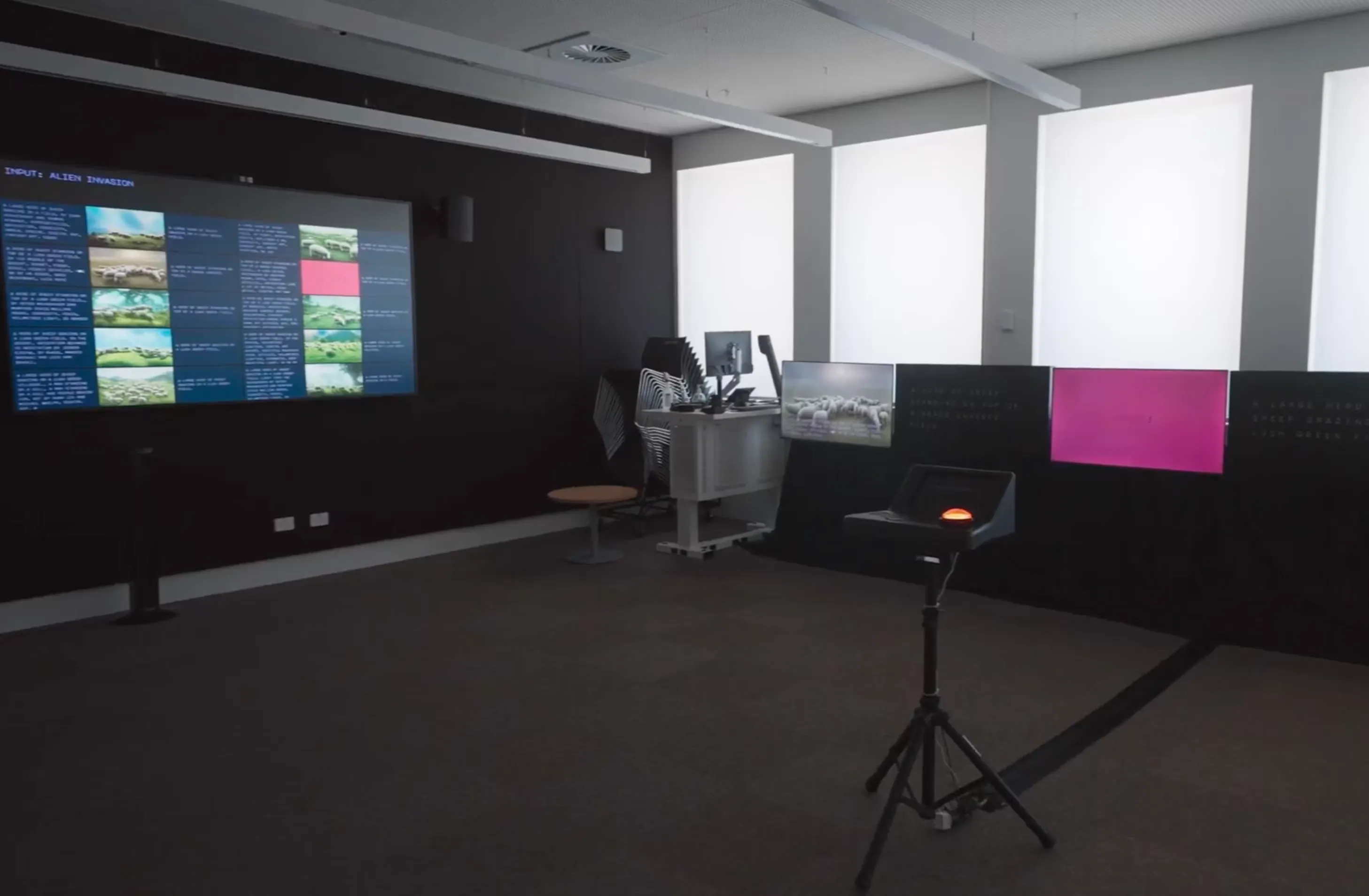
PANIC! — Playground AI Network for Interactive Creativity — is an interactive installation that connects generative AI models end-to-end in feedback loops and lets you watch what happens. Take a text-to-image model, feed its output into an image-to-text model, loop the result back around, and stand back.
What happens when AI models talk to each other
Think of it as a game of Telephone where the players are billion-parameter neural networks. A starting prompt produces an image, which gets described in words, which produces a new image, which gets described again — on and on. The interesting part isn’t what any single model does. It’s the emergent behaviour of the coupled system: recurring visual motifs, strange attractors in meaning space, and occasionally complete collapse into nonsense. The trajectories are genuinely unpredictable — a seemingly innocuous starting prompt can spiral in directions nobody anticipated.
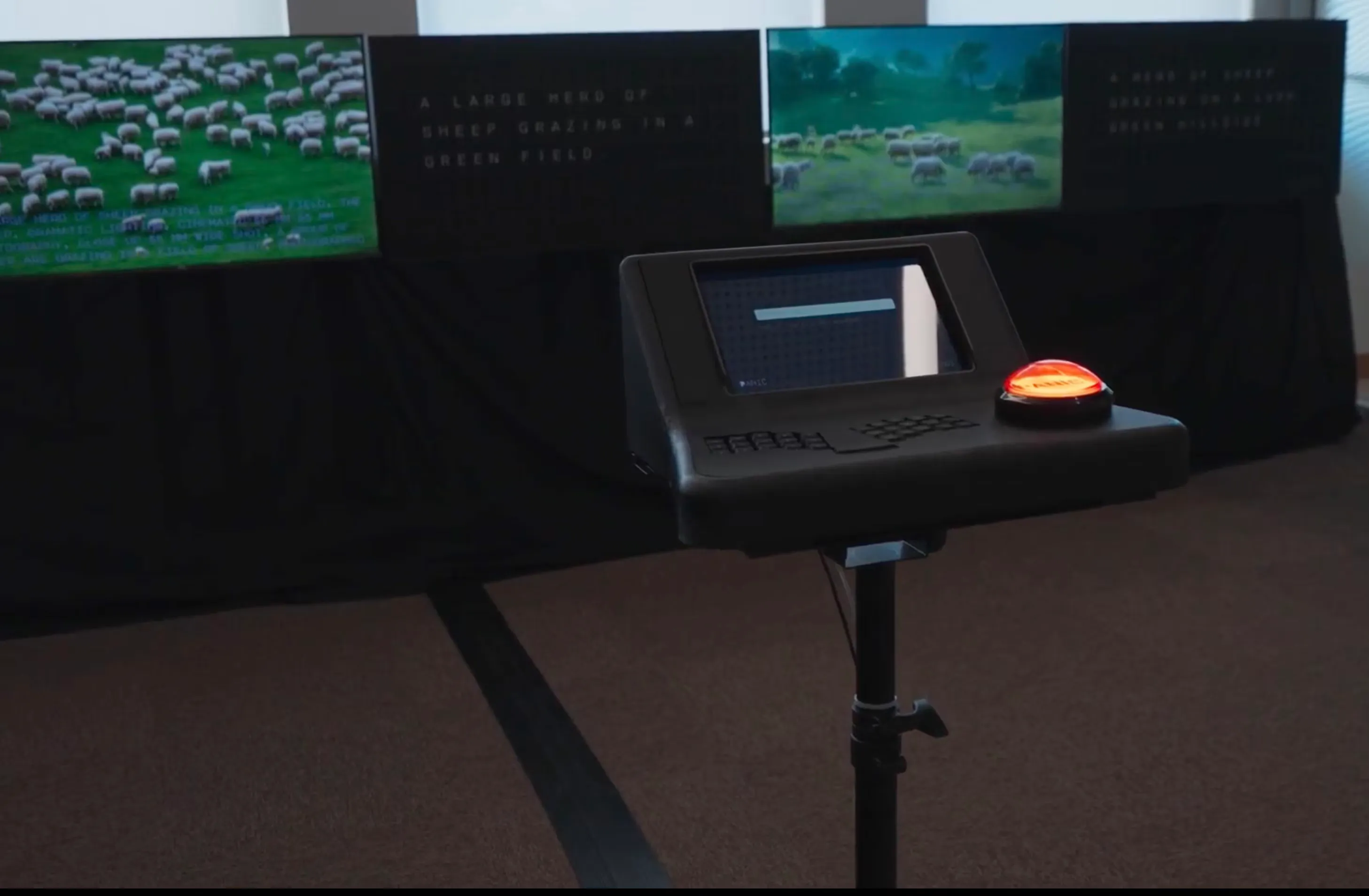
Different ways of wiring the models together produce fundamentally different dynamics. Swap in a different image generator or change the captioning model and the whole character of the system shifts. This is the core cybernetic insight PANIC! is built around: feedback loops — and the connections between components — define the behaviour of the systems in which we live, work and create. The individual parts matter far less than how they’re coupled.
One of the more revealing demonstrations is what we call “camel erasure”. Feed in a picture of a camel and watch it get quietly replaced by a giraffe within a few iterations, because the captioning model doesn’t recognise camels particularly well. The bias here isn’t a property of any individual model — it’s an emergent property of the loop. You only see it when the models start talking to each other.
There’s a deeper point here, drawn from second-order cybernetics: you’re always part of the system you’re observing. Every prompt is an intervention, every observation a perturbation. When visitors interact with PANIC!, they’re not just watching AI do its thing — they’re steering the system, whether they intend to or not.
How it works
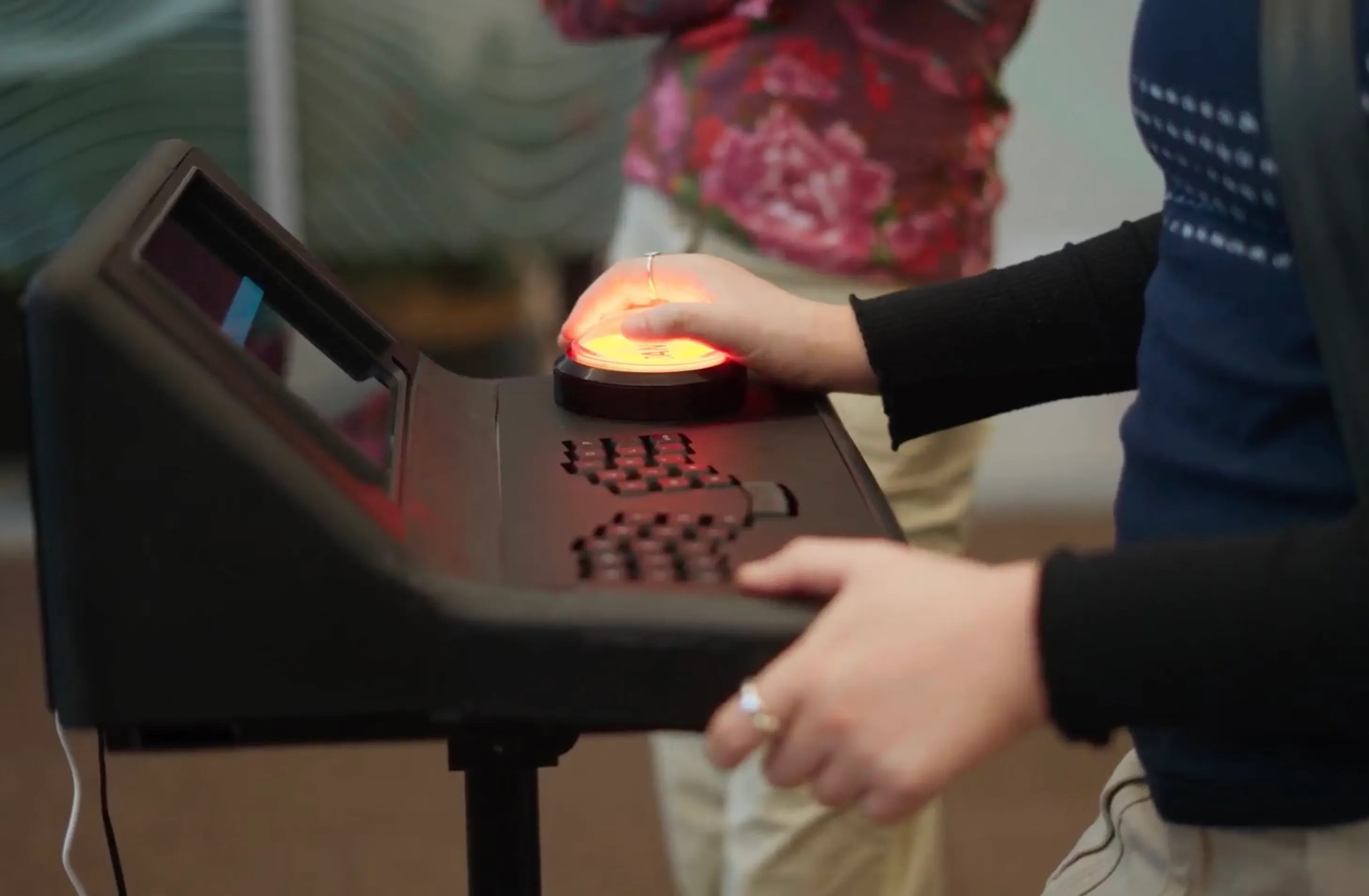
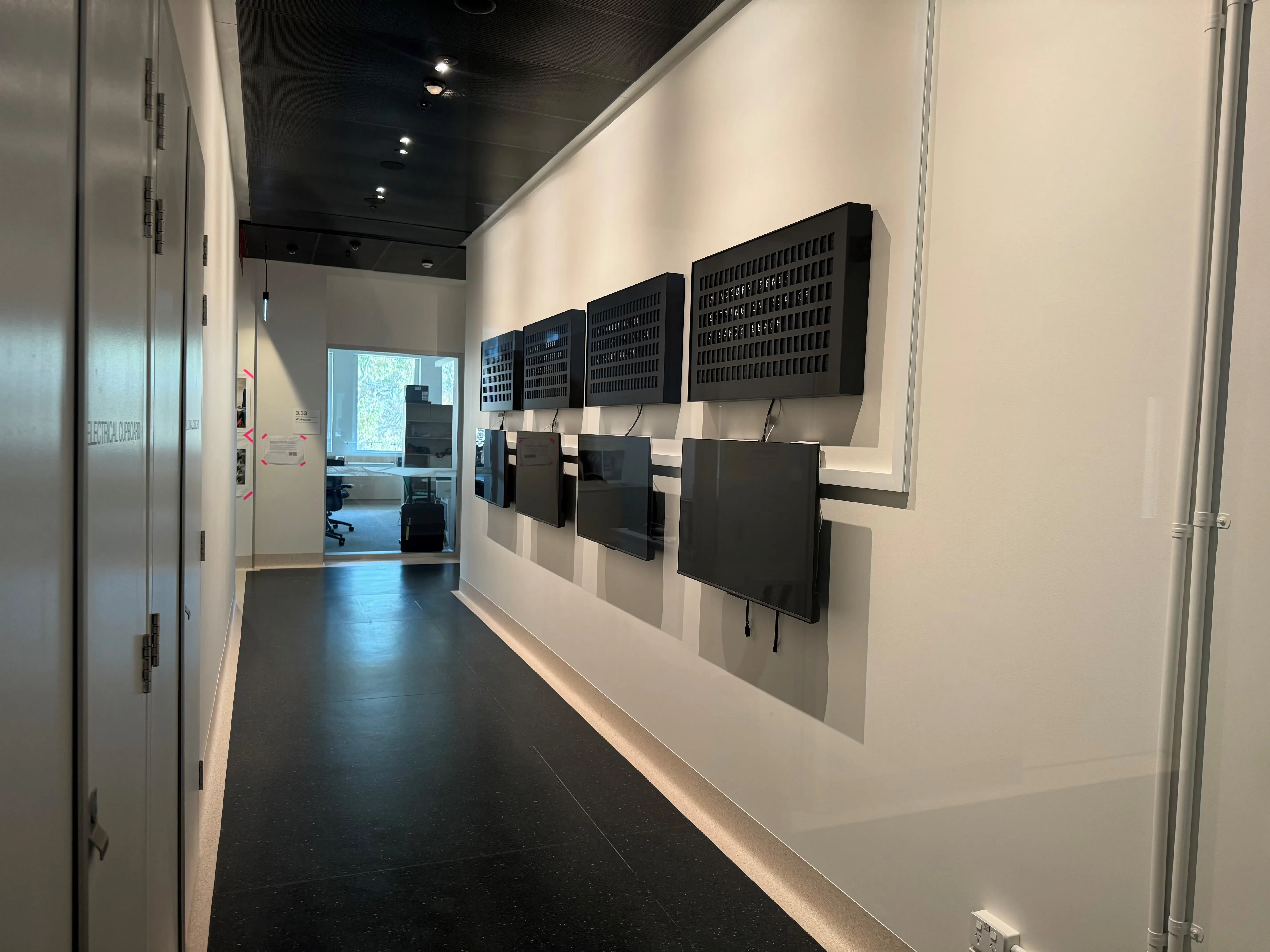
The installation runs as an Elixir web application that orchestrates the feedback loop in real time. Models from different cloud platforms — OpenAI, Replicate, Gemini — can be swapped in and out of the network, and their outputs stream live to screens, terminals, and Vestaboard split-flap displays. The architecture treats the network topology itself as the central object: which models are connected, in what order, and how their outputs route to one another.
Alongside the installation, there’s a research programme investigating the mathematical structure of these feedback trajectories. Running thousands of iterations across different model configurations, we embed each output into a high-dimensional semantic space and use topological data analysis to characterise the shape of each trajectory. The questions driving this work are deceptively simple: are these trajectories predictable? Do they stabilise, or keep drifting? And which part of the system — the image generator, the captioner, the topology — matters most?
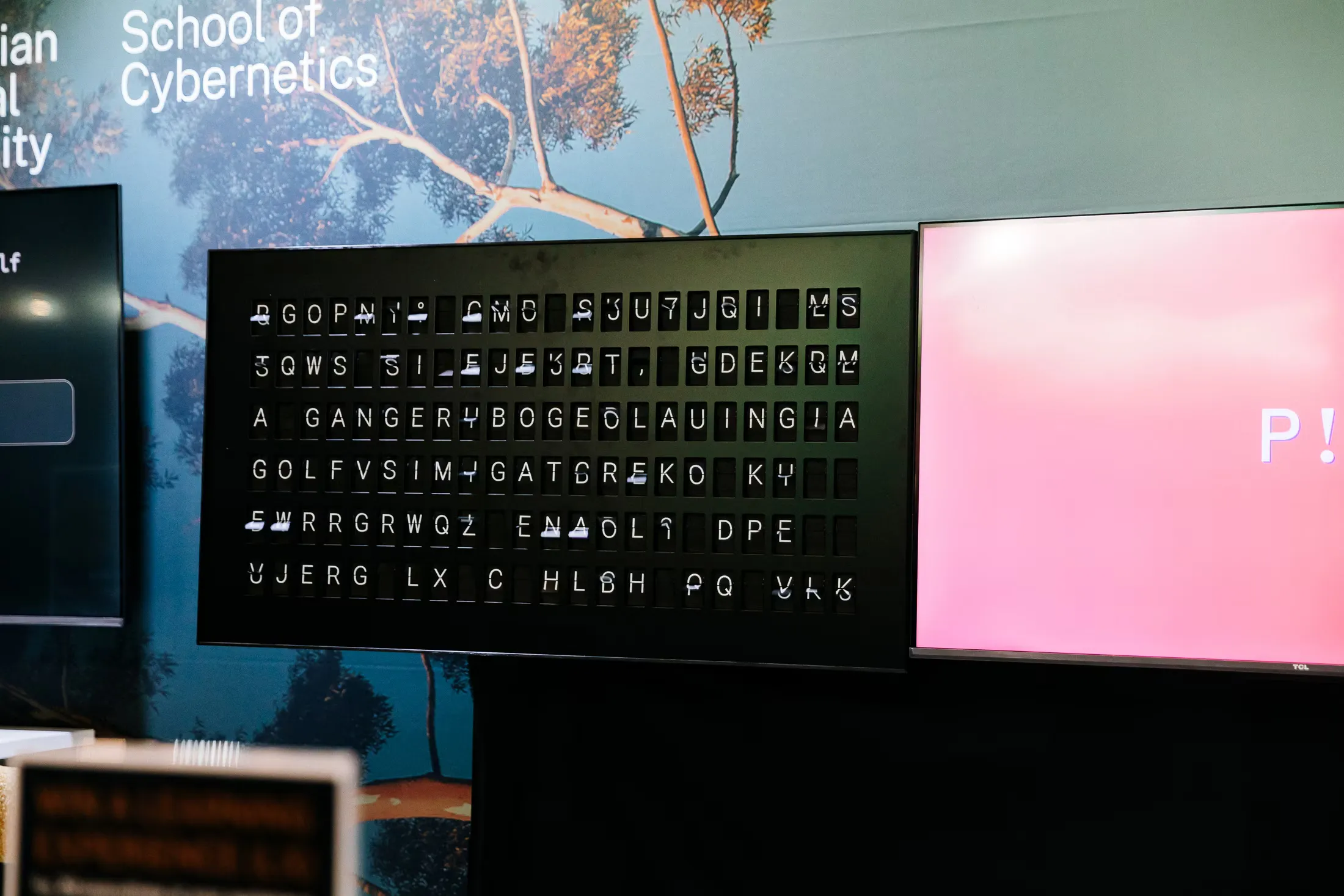
PANIC! was first exhibited at the ANU School of Cybernetics in 2022 and has since been shown at Birch (2024) and SXSW Sydney (2025). It has also been used in teaching contexts including Decoding AI courses and the Cybernetic Leadership program.